Save big on select items today!

Why Your "Rock Bottom" Is Actually the Most Solid Ground You’ll Ever Find
The Foundation Beneath the Fall Hitting rock bottom isn't a death sentence—it’s the moment the "scaffolding" of our curated identities finally gives way to solid ground. This post explores the transformative power of the abyss, where the exhaustion of pretense ends and real foundations are poured. Learn how to stop fighting the fall and begin the slow, holy work of rebuilding a life on the unyielding reality of grace.
HONEST IDENTITYFINDING GOD IN THE DIRTRISING FROM THE RUBBLETHE ARCHITECTURE OF GRACESACRED SURVIVAL
Cole Ransom
3/24/20263 min read
Why Your "Rock Bottom" Is Actually the Most Solid Ground You’ll Ever Find
There is a specific, visceral vertigo that accompanies the sensation of losing everything. We spend the better part of our lives painstakingly erecting scaffolding around our identities—weaving together careers, reputations, and curated social standings—all while harboring a subterranean terror of what might happen if the structure were to buckle. When the collapse finally comes, it brings a crushing weight of shame and a silence so heavy it feels physical. We treat this descent like a death sentence, a final curtain call for the life we spent so long auditioning for. Yet, hitting the absolute bottom is rarely an ending. It is, instead, a brutal but necessary stripping away of the masks we have worn, a moment where the frantic theater of "making it" finally gives way to the stark, unyielding reality of being.
The Architecture of the Abyss
We often mistake "rock bottom" for a place of total instability, but the inverse is true. In the midst of a crisis, we exhaust ourselves in the "scrambling and pretending"—the frantic, soul-sucking effort to hold up a facade that has already cracked. The descent only truly stops when you finally strike a surface that cannot give way any further. There is a strange, terrifying relief in hitting the floor; the energy once wasted on pretense is suddenly available for something else. When you have no lower to fall, you finally have the raw materials to begin again. In this low, quiet place, you stop surviving on appearances and begin the grueling work of real life. This shift in perspective is the moment the Architect takes over:" Now I know it’s where foundations get poured."
When the Scrambling Stops
The "stripping" process that occurs during a great fall is a fundamental transformation of identity. You are forced to abandon the persona you wore—that polished, curated version of yourself designed for public consumption—and confront the soul you buried beneath the noise. This collapse creates a rare, hallowed space where the world’s expectations are silenced, and truth finally has room to speak. The mask has failed you. The soul remains.
The Heavy Holiness of the Inch
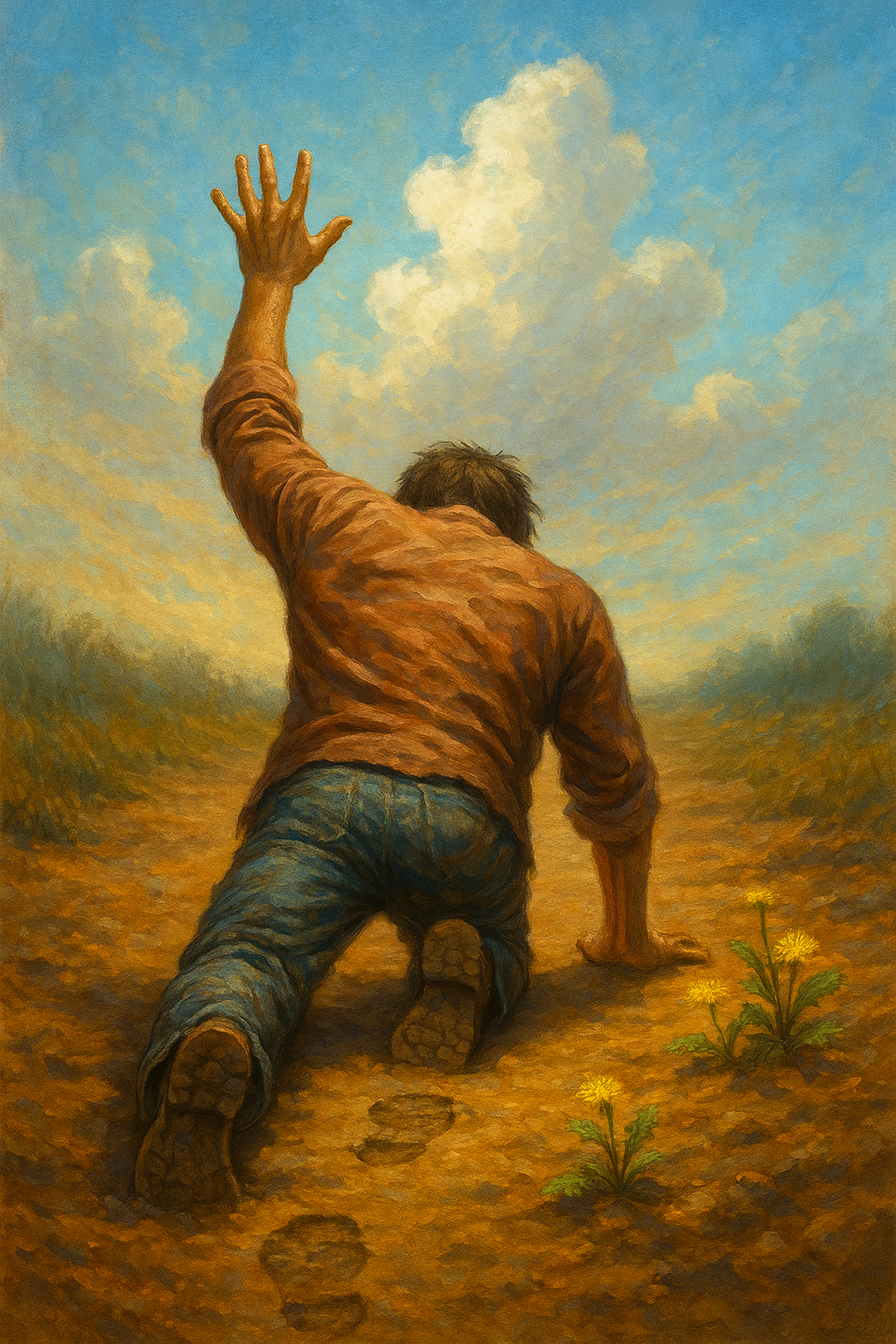
Contrary to the narratives we see in cinema, recovery is rarely characterized by a sudden, blinding flash of light. It does not arrive as a triumphant montage. Instead, the rise from the bottom is a slow, grueling climb that occurs in increments so small they feel almost invisible. It is found in the rhythm of shaky hands and ugly cries. It is found in cold coffee mornings where the only victory is the decision to stay awake, scribbling half-prayers into a dollar store journal with a pen that barely works.There is a sacred, heavy quality to a person who begins to build themselves back up using only bare hands and borrowed grace. This messy, unpolished ascent is what makes the process "holy." It is a testament to a resilience that isn't found in easy victories, but in the decision to rise in silence, one inch at a time. There is no cinematic montage, only the slow, quiet work of a life being reclaimed:"I didn’t rise in a flash of light. I rose in inches."
The Divine Architect in the Deep
It is human nature to interpret a significant fall as a punishment, a divine "no" to our ambitions. But if we look closer, we see that rock bottom is not a prison—it is potential. A shallow foundation cannot support a cathedral; similarly, some transformations require a depth that only a total clearing can provide. It is the only place deep enough for God to build something truly new, something that doesn't rely on the flimsy scaffolding of our own making.This transition from the depths is captured in the ancient resonance of Psalm 40:2, which speaks of being brought up out of a "horrible pit" and the "miry clay." The purpose of the pit is not to swallow the traveler, but to provide the context for their feet to be set upon a "rock," establishing a new and more stable way of moving through the world. There is a profound relief in being brought up by something larger than oneself, feeling your footing shift from the sinking mud of performance to the solid stone of grace.
A Final Thought for the Weary
If you find yourself at the bottom today, understand that the rough, lonely nature of this place does not mean your story has reached its conclusion. This moment of failure is not a destination; it is a clearing. The old scaffolding has fallen away because it was never meant to hold the weight of who you are becoming. You are not alone in the pit, and more importantly, you are not finished. If you stopped fighting the fall and started feeling the floor, what new foundation could you begin to pour today?
Faith For Misfits
Contact
Newsletter
admin@faithformisfits.com
© 2026. All rights reserved.